

Pixie hairstyles for thick hair cuts have a complicated reputation. Some stylists treat density as a problem to hide, others treat it as the reason a pixie works so well in the first place. The truth sits in between. Thick hair holds shape, adds texture, and rarely looks thin or flat, but it also needs a cutting plan that removes bulk in the right places instead of just shortening the outline.
This guide breaks down which pixie shapes actually suit thick hair, how density and wave pattern change the right cut, and what to say in the chair so you don’t end up with a rounded, helmet-like shape by accident.
Try pixie hairstyles for thick hair before the salon
If you’re moving from medium or long hair straight into a pixie, the biggest surprise is usually volume. Thick hair holds more shape after cutting than most people expect, especially on top and at the crown. Before committing at the salon, it helps to see the outline on your own face rather than on a model with different density.
A quick virtual preview can show how a textured pixie, a curlier short cut, or a softer layered option would actually sit on your head shape, so the in-chair conversation starts from a realistic picture instead of a guess.
Key takeaways
- Thick hair usually needs weight removed from inside the cut, not just a shorter outline.
- A long pixie or bixie is the safer starting point because it leaves room to go shorter later.
- Tapering at the sides and nape controls bulk without making the cut look severe.
- Curly or strongly wavy thick hair should keep extra length on top so the curl pattern can form properly.
- An undercut can manage very dense hair well, but it changes how the cut grows out.
- Bring side and back reference photos, not only front-facing inspiration.
- Gentle handling matters more with short thick hair, since it tends to get restyled daily.
Contents
- Quick answer
- Best pixie haircuts for thick hair
- Choose by density and texture
- Face-shape notes
- What to ask your stylist
- Styling thick pixie hair
- Taper, undercut, or layers?
- Grow-out plan
- When to wait
- FAQ
Quick answer
For thick hair, start with a long textured pixie or a bixie rather than a very short, tight pixie. Ask your stylist to remove weight from inside the haircut, keep some length through the top for movement, and taper the nape and sides gradually instead of cutting them blunt. If the sides are especially dense, ask about a light taper first before deciding on a full undercut, since an undercut is a bigger commitment to maintain.
A simple way to brief your stylist:
“I have thick hair and want a pixie that doesn’t look round or bulky on top. Please thin the hair internally, keep some length and movement through the crown, and taper the sides and nape so they lie flat.”
If your hair is wavy or curly, add a note about shrinkage:
“My hair shrinks when it dries, so please cut with that in mind and leave the top long enough for my natural texture to show.”
Read More: Hair Cutting Style Man Image: Bridging the Gap Between Vision and Reality
Best pixie haircuts for thick hair
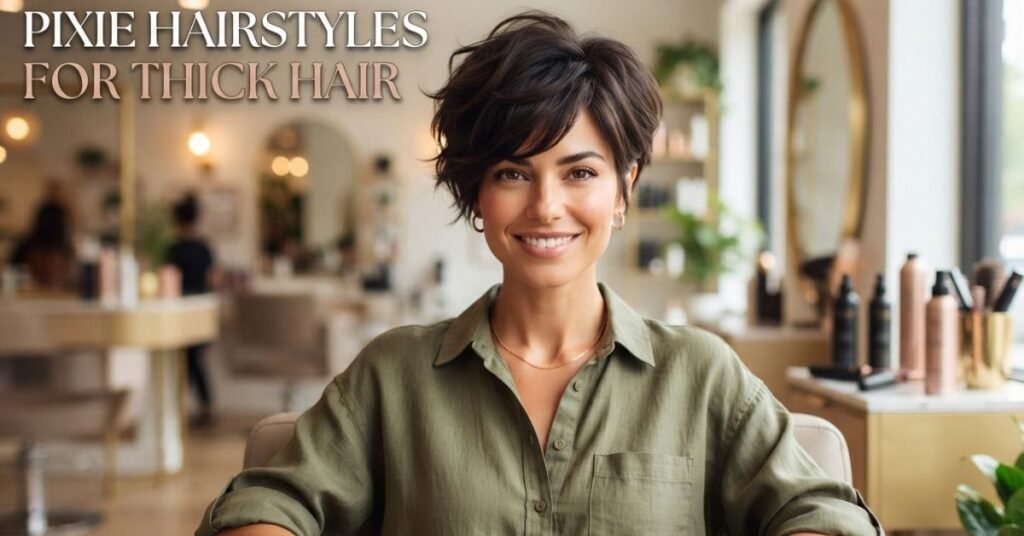
Not every pixie style suits every density. The table below compares the most requested pixie variations for thick hair, based on what stylists and thick-haired clients consistently flag as working well.
| Pixie style | Best for | Why it suits thick hair | Watch out for |
|---|---|---|---|
| Long textured pixie | A first short cut, thick straight or wavy hair | Removes bulk while keeping softness on top | Crown can still look full if not layered internally |
| Tapered pixie | Heavy sides and nape | Gradually thins the outline instead of cutting it blunt | Can look uneven if the top isn’t balanced against it |
| Bixie | Anyone unsure about going fully short | Bridges a bob and a pixie, so there’s room to adjust | Needs regular shaping or it can look formless |
| Shaggy pixie | Thick wavy hair and a relaxed, textured style | Turns natural volume into deliberate texture | Needs a clean base shape underneath the shag |
| Undercut pixie | Very dense or hot-at-the-scalp hair | Hides removed weight beneath the top layer | Regrowth at the undercut becomes visible faster |
| Curly pixie | Thick curls or strong waves | Keeps curl definition visible while controlling sides | Curl shrinkage can make the result shorter than expected |
| Side-swept pixie | Round, square, or heart face shapes | Diagonal fringe softens strong jaw or forehead lines | A heavy side fringe needs thinning so it doesn’t clump |
| Piecey crop | Straight, coarse, thick hair | Creates separation across a dense surface | Overusing wax can make ends feel stiff |
| Spiky or asymmetrical pixie | Thick straight hair, bolder personal style | Uses volume as a design feature instead of fighting it | Needs strong product and regular reshaping |
Choosing between these usually comes down to which problem bothers you most. Heavy sides point toward tapering. A stiff-looking crown points toward internal layering. Nervousness about going too short points toward a bixie as the safer first step.
Try a textured pixie
Before cutting, it’s worth checking how a textured pixie actually frames your face rather than relying on a stranger’s hair density in a photo. Comparing a shorter, more textured shape against your current length can make the decision at the salon much easier, and it gives you language to describe exactly what you want kept and what you want removed.
Read More: Low Taper Fade Buzz Cut: 26 Best Styles for Men in 2026
Choose by density and texture
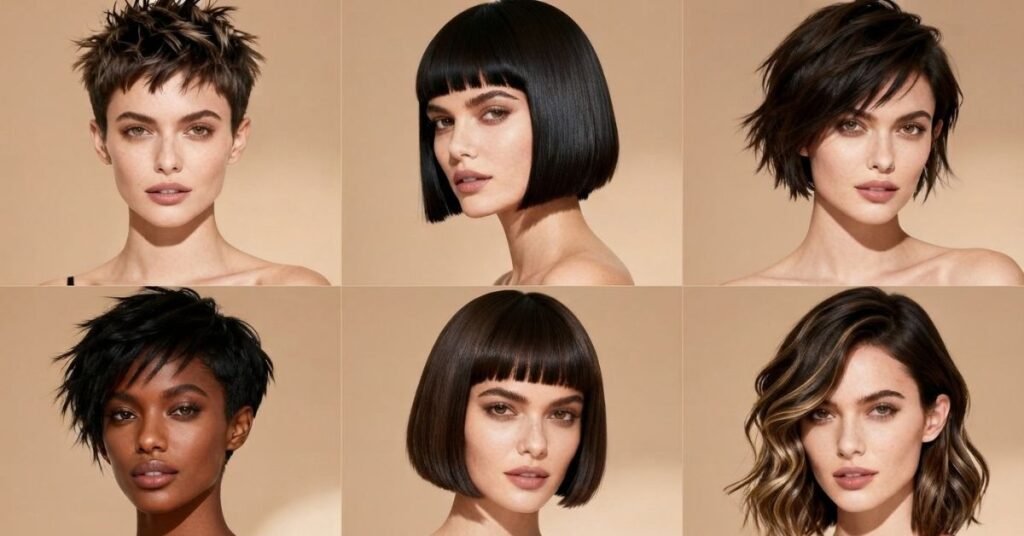
“Thick hair” isn’t one category. Two people with equally dense hair can need opposite approaches depending on strand thickness and wave pattern.
| Hair type | Better pixie direction | What to avoid |
|---|---|---|
| Thick straight hair | Piecey crop, tapered pixie, long textured pixie | A blunt, heavy top with no separation |
| Thick wavy hair | Shaggy pixie, side-swept pixie, longer pixie | Cutting too short before seeing how it dries |
| Thick curly hair | Curly pixie with extra top length | Wet cutting that ignores how much the curl will spring up |
| Very dense sides | Taper or a hidden undercut | Leaving the side panels solid and square |
| Heavy nape | Tapered, cleaned-up neckline | A bulky back section that looks grown out within weeks |
| Coarse thick hair | Internal layering plus soft edge work | Overusing thinning shears through the ends |
| Fine but dense hair | Long pixie or bixie with light movement | Removing so much weight the ends look sparse or wispy |
Weight removal shouldn’t mean shredding the ends until they frizz. If your hair reacts badly to thinning shears, ask which technique your stylist plans to use. Point cutting, slide cutting, razor work, and a small undercut all thin hair differently, and the right choice depends on your specific texture, not a one-size approach.
Face-shape notes
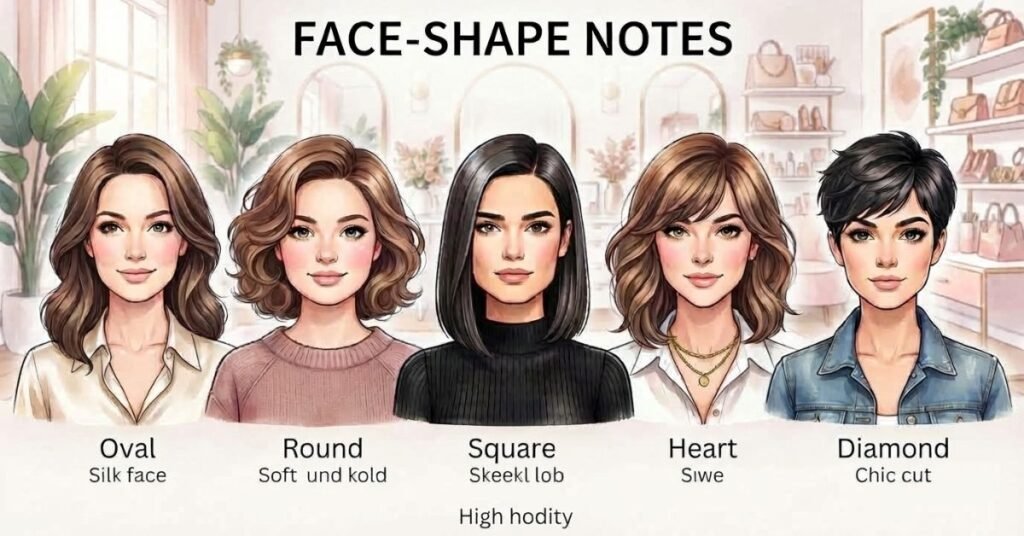
Face shape only tells half the story. A pixie that flatters a round face on fine hair can widen it further on thick hair if the sides aren’t controlled.
| Face shape | Strong pixie direction | Adjustment for thick hair |
|---|---|---|
| Round | Side-swept, tapered, long textured pixie | Keep sides tight and add height or diagonal movement at the crown |
| Square | Soft feminine pixie, shaggy pixie, longer fringe | Break up hard lines near the temples and jaw with texture |
| Long | Bixie, fuller fringe, lower crown volume | Avoid excess height that stretches the face further |
| Heart | Side fringe, long pixie, tapered nape | Keep softness near the forehead and cheekbones |
| Oval | Most pixie shapes work | Base the choice on texture and maintenance rather than shape alone |
| Diamond | Long pixie, side-swept, textured crop | Avoid adding bulk right at the cheekbone line |
If face shape is your main concern, it’s worth comparing a short cut side by side with your natural face proportions, since a pixie changes the balance between forehead, cheekbones, and jaw far more than longer hair does.
What to ask your stylist
Thick pixies often look great from the front and then fall apart at the ears or nape, because those areas weren’t part of the plan. Bring references that show the side and back, not just a front-facing photo.
A useful checklist to run through in the chair:
- “Please remove weight from inside the cut, not only at the ends.”
- “Keep enough length on top for movement, don’t cut it flat.”
- “Taper the nape and sides so they don’t puff out as the day goes on.”
- “Avoid leaving the top as one solid, round shape.”
- “Show me how much product this will realistically need day to day.”
- “If you use a razor or thinning shears, keep the ends from looking fuzzy.”
- “I’d rather this grow into a bixie or short bob than into a mushroom shape.”
For a first pixie, consider asking your stylist to leave slightly more length than the “ideal” short version. You can always go shorter at the next appointment. You can’t add back side length if the first cut goes too tight.
Styling pixie hairstyles for thick hair
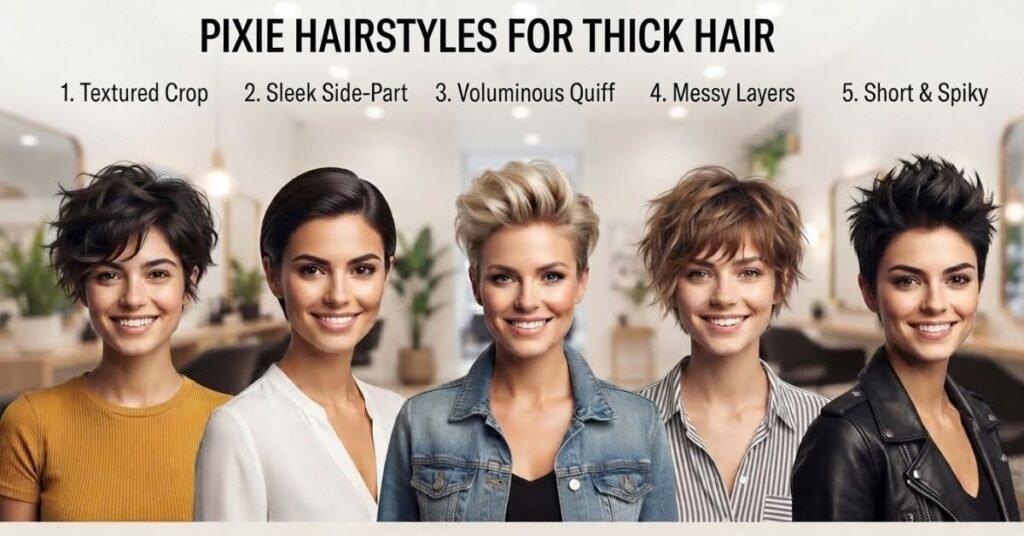
Less product goes further than people expect. Thick short hair stiffens quickly because there’s nowhere for extra paste or cream to disappear into. Start small, a pea-sized amount of matte paste, light cream, or a flexible styling balm, warmed between the palms and worked through the mid-lengths and ends rather than the roots.
For straight thick pixies:
- Lightly dampen the top section.
- Blow-dry in the direction you want it to sit.
- Add a touch of paste only where pieces need separation.
- Finish with fingers rather than a hard-bristled brush.
For wavy or curly thick pixies:
- Apply a small amount of curl cream while hair is still damp.
- Scrunch the top gently in the direction of the natural wave.
- Air dry, or diffuse on a low heat setting.
- Separate just a few pieces once fully dry.
The American Academy of Dermatology recommends gentle handling and limiting habits that repeatedly stress the hair, which is worth remembering with a short thick pixie, since the front, crown, and sides typically get restyled every single morning. If a cut only holds together with heavy heat and product daily, that’s usually a sign the shape needs adjusting rather than a styling problem.
Try a curl-friendly short cut
If your hair is wavy or curly, it’s worth checking whether keeping a bit more texture on top actually looks better than forcing the wave pattern flat. A short preview against your own curl pattern can prevent a common mistake: cutting for a straight-hair silhouette on hair that was never going to sit that way.
Taper, undercut, or layers?
These three terms get used almost interchangeably, but they solve different problems.
| Technique | What it does | Best used when | Watch out for |
|---|---|---|---|
| Taper | Gradually shortens hair around the nape or sides | The outline bulks up quickly through the day | Too high a taper can start looking like a fade instead of a soft pixie |
| Undercut | Removes hidden weight underneath the top layer | Sides run hot or feel extremely dense | Regrowth can look disconnected within a few weeks |
| Internal layers | Thins weight inside the top and sides | The hair forms a heavy, cap-like shape | Poor placement can create frizz or visible gaps |
| Point cutting | Softens edges and breaks up a blunt surface | Ends look too straight-edged or harsh | Overdoing it can make the whole shape look fuzzy |
| Longer fringe | Adds face-framing and more styling options | You want a softer, more forgiving first cut | A heavy fringe needs thinning or it clumps together |
If you’re unsure where to start, tapering plus internal layers is a safer entry point than a visible undercut. An undercut can work very well on dense hair, but it’s a bigger commitment than most people expect, both in upkeep and in how obviously it grows out.
Grow-out plan
A thick pixie needs a grow-out plan from the first appointment, not as an afterthought. Without one, the sides and back tend to get bulky before the top has grown enough to shift into a bixie or bob shape.
Ask your stylist for:
- A nape shape that’s easy to clean up every 4 to 6 weeks.
- Side length that can either stay tapered or transition into a short bob later.
- A top section that isn’t cut so short it sticks straight up mid-growth.
- A fringe plan if the long-term goal is a bixie rather than a permanent pixie.
Most people need a cleanup appointment before they need a full reshape. A quick trim at the nape and sideburns can keep a growing-out pixie looking deliberate while the top length catches up.
Read More : Low Taper Fade Textured Crop Haircut: Top 26 Best Styles for Men in 2026
When to wait
There are a few situations where it’s worth holding off on a pixie, even if you’re ready for the change.
- Your hair is breaking at the crown, recovering from heavy color or bleach, or shedding more than usual. A pixie exposes the hair’s surface, so any breakage or uneven density becomes much more visible.
- You have a major event within the next two weeks and no time to adjust to the change.
- You only like pixies in heavily styled reference photos, not realistic everyday versions.
- You strongly dislike seeing your ears or neckline exposed.
- You regularly need to tie your hair back for work, sport, or other practical reasons.
- You’re not able to commit to trims every 4 to 8 weeks.
If any of these apply, a bixie, short bob, or long layered cut can be a better first step. It still delivers a noticeably shorter, lighter feel while keeping more styling flexibility and an easier grow-out.
Try a softer backup option
If a full pixie feels like too big a jump, it’s worth comparing a layered option that removes weight while keeping more overall length. Seeing both choices side by side on your own hair often makes the decision far easier than debating it in the abstract.
FAQ
Is a pixie cut good for thick hair?
Yes. It works well when weight is removed internally rather than just shortened at the ends. A poorly done thick-hair pixie usually looks too round or too heavy in the wrong spots, not simply “too short.”
What pixie cut is best for very thick hair?
A tapered pixie, long textured pixie, or a pixie with a hidden undercut works best. Each controls bulk near the ears and neckline while leaving movement on top.
Should thick hair be thinned for a pixie?
Usually, but not always with aggressive thinning shears. Internal layering, point cutting, slide cutting, and light tapering can remove weight without leaving the ends frizzy.
Is a bixie better than a pixie for thick hair?
For a first short cut, often yes. A bixie keeps more softness and coverage around the ears and neck, and it still leaves room to go shorter at a later appointment.
How often should thick pixie hair be trimmed?
Most thick pixies need a cleanup every 4 to 8 weeks, with the nape and sides sometimes needing attention sooner since dense hair grows out bulky faster than fine hair.
What should I preview before cutting a pixie?
Check the front shape, side volume, fringe direction, and neckline together. Thick hair can look great from the front and still feel too wide at the sides once it’s finished.
Final thoughts
A pixie can absolutely work for thick hair, but the cut only succeeds when density is planned for from the start rather than corrected after the fact. Internal weight removal, a sensible taper at the nape and sides, and enough length on top for your natural texture are the three things that separate a pixie that looks intentional from one that looks like it grew out overnight. If you’re still unsure how short to go, a bixie or long textured pixie gives you nearly all the benefits of a short cut with far less risk, and it leaves the door open to go shorter once you’ve lived with the shape for a few weeks.


1 thought on “Pixie Hairstyles For Thick Hair: Tapered, Textured, and Bixie Options”